
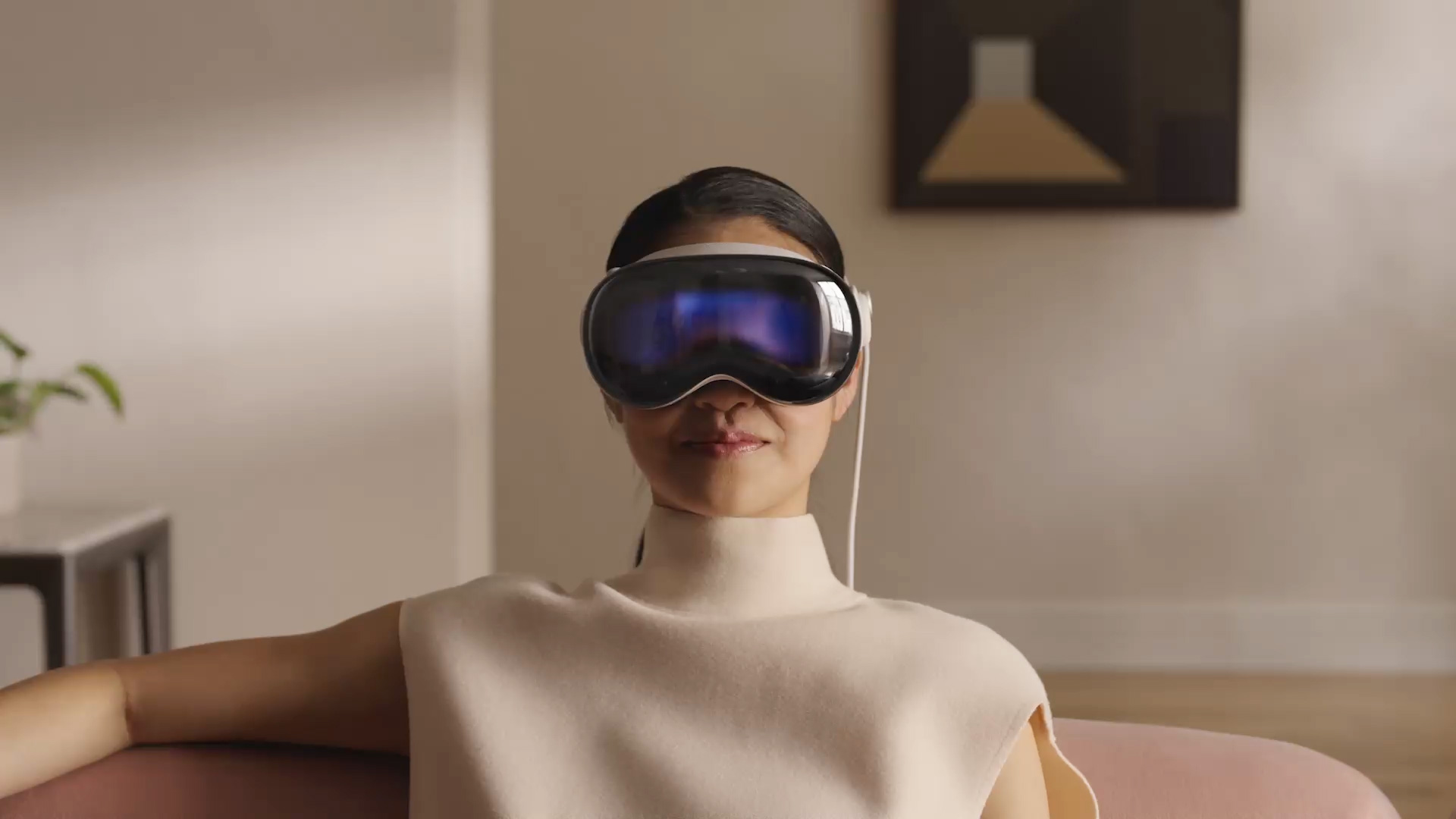
The Micro-OLED Mastery: Visual Integrity as a Productivity Engine
The defining experience of the Vision Pro 2026—now running the highly matured visionOS 26—is its unparalleled visual density. With 23 million pixels distributed across two Micro-OLED displays, it remains the only headset where text is as legible as on a physical 5K Studio Display. This has solidified its position not as a gaming toy, but as a legitimate workstation for the "infinite desk" professional.
The user experience has been refined to eliminate early "V1" frictions. The introduction of the Apple M5 chip and the dedicated R1 co-processor in the 2026 refresh has further reduced latency, while the "Dual Knit Band" and lighter internal alloys have addressed the fatigue issues that plagued original adopters. In this ecosystem, the OS has evolved into a "Spatial Desktop" where widgets are no longer flat icons but 3D objects that anchor to your physical furniture, allowing for a persistent, multi-screen environment that follows you from room to room with eerie stability.
The Generative Shift: Spatial Scenes and AI-Driven Immersion
As we move through 2026, Apple has successfully integrated its "Apple Intelligence" suite deep into the spatial fabric. The standout feature is Spatial Scenes, a generative AI algorithm that can transform a standard 2D iPhone photo into a fully realized 3D environment. This allows users to literally "step into" their memories, with the AI synthesizing depth and perspective that feels physically present.
Furthermore, the Persona 26 update has finally crossed the uncanny valley. By utilizing industry-leading volumetric rendering and machine learning, digital avatars now display realistic hair physics, micro-expressions, and skin textures. For global teams, this has made spatial FaceTime calls the gold standard for executive collaboration, providing a level of "presence" that standard 2D video conferencing cannot replicate. With the release of Enterprise APIs, the Vision Pro has also found a home in high-stakes fields like surgical simulation and aerospace design, proving that when the cost of an error is high, the cost of the hardware is irrelevant.
Absolute Power vs. Market Friction
| Pros | Cons |
| Highest-resolution displays in the consumer market (~3660x3200 per eye) | High entry price ($3,499+) remains a barrier for mainstream adoption |
| visionOS 26 offers the most fluid, intuitive eye-and-hand tracking | External battery pack and 2.5-hour life limit long-term mobility |
| Revolutionary M5/R1 silicon architecture for zero-latency compute | Weight and bulk still lead to fatigue during 3+ hour sessions |
| Deepest ecosystem integration with Mac, iPhone, and Apple Intelligence | Competitive "Vision Air" models are beginning to cannibalize the base |
The Apple Vision Pro 2026 is the premier choice for the professional pioneer who refuses to compromise on the quality of their digital reality. It is a masterclass in "muscle-flexing" engineering, proving that while others may sell more units, Apple is the only one defining the standard of what a spatial computer should be.