
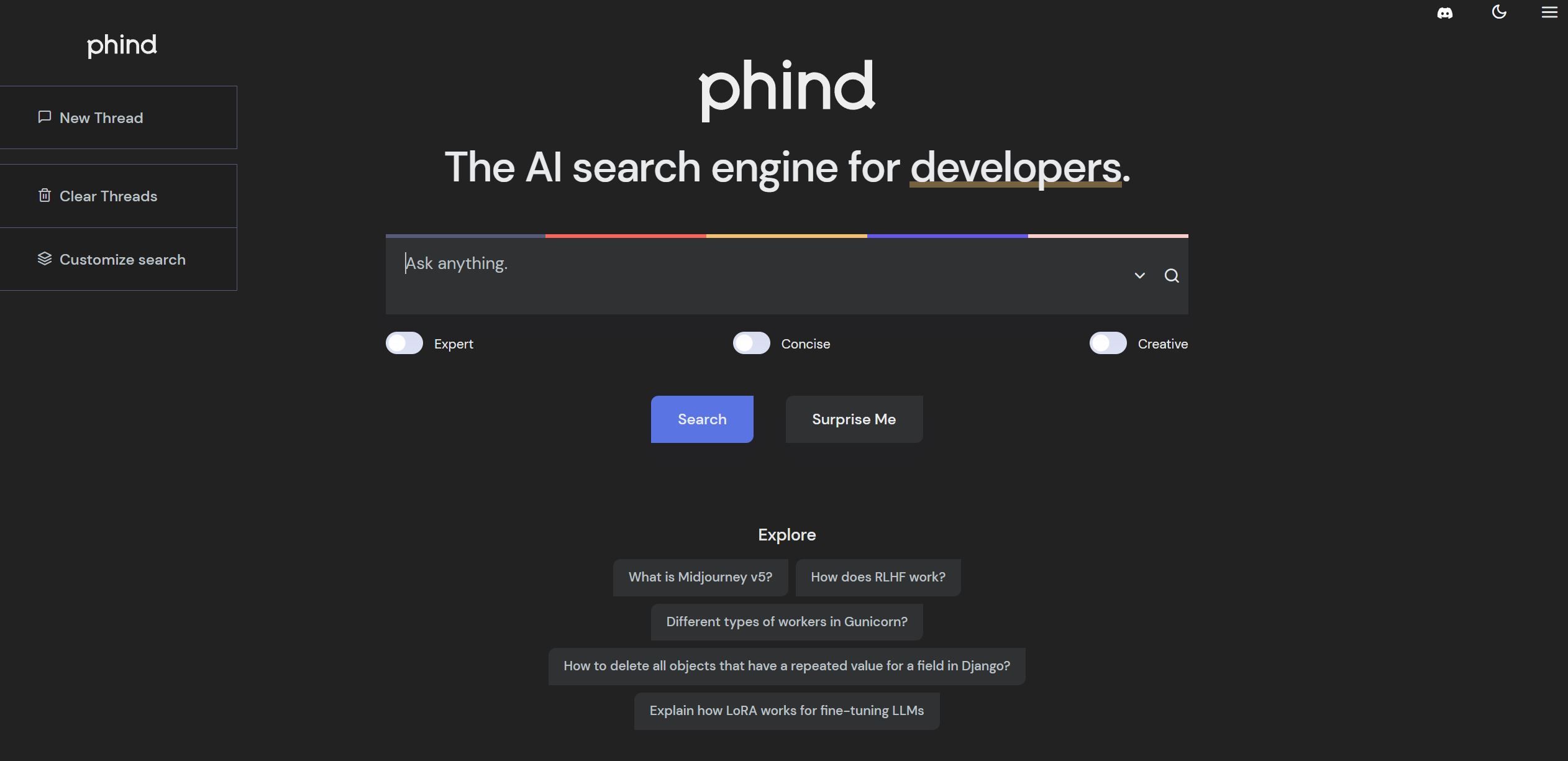
The Search-First Advantage: Precision Over Poetry
The genius of Phind lies in its fundamental refusal to rely solely on static training data. While traditional LLMs are frozen in the time of their last update, Phind’s UX is built on a "Search-to-Synthesis" loop that feels like magic. When you query a breaking change in a niche framework like SvelteKit or a new Rust crate, Phind doesn't guess; it crawls official documentation, GitHub discussions, and Stack Overflow in real-time before drafting its response. The interface is refreshingly focused, stripped of the bloat found in generalist tools. By presenting the sources alongside the solution, it restores the developer’s agency, allowing for a "trust but verify" workflow that is essential for high-stakes engineering. This is UX designed for the "flow state," where the gap between a technical question and a paste-ready answer is measured in seconds, not paragraphs of conversational fluff.
The Phind-70B Engine: Hard-Coded for Logic
Under the hood, Phind’s technical edge in 2026 is its proprietary Phind-70B model, a powerhouse fine-tuned specifically for the semantic nuances of code. Unlike GPT-5 or Claude 4, which are broad enough to write sonnets, Phind-70B is architected for architectural reasoning and debugging. It excels at the "multi-step self-correction" phase; if a generated solution feels suboptimal, the model autonomously triggers a secondary web search to cross-reference the latest best practices. Its integration into Visual Studio Code via the Phind Extension has become a developer favorite, providing in-editor explanations that actually understand the context of your local repository. It doesn't just suggest the next line of code; it explains why the current one is failing, effectively acting as a senior peer reviewer who never sleeps.
The Developer’s Ledger: Accuracy vs. Atmosphere
As the AI coding market fragments into specialized niches, Phind’s survival depends on its ability to remain the fastest, most accurate "technical oracle" on the web.
The Engineering Intelligence Audit
| Technical Highs (Pros) | Operational Lows (Cons) |
| Real-time internet access ensures answers reflect the latest library updates. | Specialized focus means it lacks the "creative" brainstorming of general LLMs. |
| Phind-70B generates code with a 92% paste-ready success rate. | The free tier has significant daily limits on the most powerful models. |
| Superior citation system links every line of code to its source documentation. | VS Code extension is powerful but can be resource-heavy on older machines. |
| Extremely fast inference speeds (80+ tokens/sec) minimize cognitive breaks. | Still occasionally struggles with highly abstract software architecture theory. |
Phind is the tool for the developer who is tired of arguing with a chatbot. It is a precision instrument designed for the reality of 2026, where the volume of technical information is too vast for any human to track. By combining the currentness of the web with the reasoning of a top-tier model, it has become the definitive search engine for those who build the future.